Showing posts with label TIPS & TRICKS. Show all posts
LEOPRABU

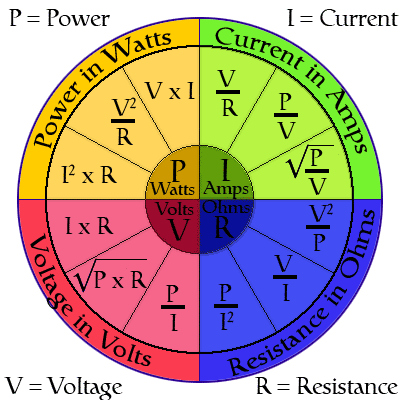
FORMULAS, EQUATIONS & LAWS

 
Symbolic:
E =VOLTS ~or~ (V = VOLTS)
P =WATTS ~or~ (W = WATTS)
R = OHMS ~or~ (R = RESISTANCE)
I =AMPERES ~or~ (A = AMPERES)
HP = HORSEPOWER
PF = POWER FACTOR
kW = KILOWATTS
kWh = KILOWATT HOUR
VA = VOLT-AMPERES
kVA = KILOVOLT-AMPERES
C = CAPACITANCE
EFF = EFFICIENCY (expressed as a decimal)
 
DIRECT CURRENT
 
AMPS=WATTS÷VOLTSI = P ÷ EA = W ÷ V
WATTS=VOLTS x AMPSP = E x IW = V x A
VOLTS=WATTS ÷ AMPSE = P ÷ IV = W ÷ A
HORSEPOWER=(V x A x EFF)÷746
EFFICIENCY=(746 x HP)÷(V x A)
 
AC SINGLE PHASE ~ 1ø
 
AMPS=WATTS÷(VOLTS x PF)I=P÷(E x PF)A=W÷(V x PF)
WATTS=VOLTS x AMPS x PFP=E x I x PFW=V x A x PF
VOLTS=WATTS÷AMPSE=P÷IV=W÷A
VOLT-AMPS=VOLTS x AMPSVA=E x IVA=V x A
HORSEPOWER=(V x A x EFF x PF)÷746
POWERFACTOR=INPUT WATTS÷(V x A)
EFFICIENCY=(746 x HP)÷(V x A x PF)
 
AC THREE PHASE ~ 3ø
 
AMPS=WATTS÷(1.732 x VOLTS x PF)I = P÷(1.732 x E x PF)
WATTS=1.732 x VOLTS x AMPS x PFP = 1.732 x E x I x PF
VOLTS=WATTS÷AMPSE=P÷I
VOLT-AMPS=1.732 x VOLTS x AMPSVA=1.732 x E x I
HORSEPOWER=(1.732 x V x A x EFF x PF)÷746
POWERFACTOR=INPUT WATTS÷(1.732 x V x A)
EFFICIENCY=(746 x HP)÷(1.732 x V x A x PF)
LEOPRABU
ELECTRIC POWER CURRENT VOLTAGE RELATIONS


LEOPRABU
There are a few students who begin their undergraduate program in engineering seeming certain and confident about what exactly they need to mind as students to be able to graduate successfully and jump start their budding engineering career. Many engineering students, however, do not seem to have the foggiest notion as to what they need to take care of in order to accomplish the same. For those in the latter group, the following are the 10 things that they should seriously take to heart in order to be successful, regardless of their chosen engineering major.

1. Have fun with your engineering courses.

Do not believe the rumor that engineering courses are just way too tough. On the contrary, engineering courses can actually be so much fun. Far from being inscrutable and indecipherable, engineering courses -- being primarily based on the principles of physics and mathematics, which are highly coherent, systematic and even elegant -- are among the most ordered, logical and, therefore, understandable courses. What is more, you will actually be able to employ these principles in designing solutions to real-world problems. If many students can ace these courses, there really is no reason as to why you should not be able to achieve the same if only you exert the necessary effort. Just always keep in mind the right approach to solving engineering problems. Always learn the pertinent theory first before solving the problem. After identifying what is required by the problem, enumerate all the known parameters, articulate your assumptions, and then solve the problem while keeping track of your units of measure. Also, always find ways, and there are always ways, to check for the correctness of your final solution.

2. Check your assumptions.

While this is part of the previous item, it really deserves its own category because this is quite crucial, not only in solving classroom problems, but also in solving all engineering design problems. The set of assumptions that you adopt, whether done consciously or unconsciously, ultimately determines the effectiveness and worth of your engineering design solution. This is true in that your assumptions are what set apart the real-world engineering design solutions from the merely ideal or imaginary design solutions. Thus what you assume has far-reaching consequences. Numerous engineering students lose their way when they transition from solving structured and well-defined classroom engineering problems (wherein almost everything is identified, from the unknown to the given parameters to what should be assumed) to solving open-ended engineering design problems -- the kind found in the real world -- primarily because they do not know the first step in making or articulating the assumptions that they should employ to solve the engineering problem at hand. Stating your assumptions is tantamount to creating a certain model for your real-world engineering problem. You would like, of course, to have a model that is as close to reality as possible. This all depends on what assumptions you make. Therefore, be always aware of what assumptions you make and validate them periodically. (Indeed, this is not just an engineering lesson, but a life lesson as well.)

3. Develop your creativity.

A myth or stereotype is perpetuated that engineers are like living automatons that deal exclusively with numbers, hardware and technical stuff, and nothing else. Absolute nonsense. Engineers are artists. No, that was not a misprint. Engineers are artists. Indeed an engineer being an artist is what enables him or her to employ his/her knowledge of numbers and hardware and technical stuff to create effective and practicable engineering solutions. To be precise, engineers are artists who are trained in the discipline of buttressing their creations (engineering design solutions) on the solid supports of the engineering sciences. Thus, it is essential for engineers to be creative. The more creative an engineer is, the more alternative solutions he or she is able to imagine for a given problem. Therefore, develop your creativity. Do not despise the assortment of non-engineering courses that you are required to take in your program since you could find in them myriads of creative ideas, constructs and systems which -- you never know -- might provide you with just the right seed of an idea that you could germinate for solving an engineering problem in the future.

4. Endeavor to learn effective communication.

Another myth or stereotype that is perpetuated is that engineers are introverts who essentially keep to themselves and are not very comfortable with language and, therefore, do not communicate well with others. This is another categorical nonsense. If engineers can be very fluent and creative in expressing abstract ideas in mathematical forms or in computer program codes – languages that are absolutely exacting and meticulous in their syntax and grammar – there is no reason as to why they could not achieve effectiveness in expressing their thoughts and ideas in English (or any other language for that matter) whose syntax and grammar are relatively far more relaxed. One key is to read widely so that you get exposed to various language and communication styles. Just because you are an engineering student does not mean that you should not read on business, politics, literary criticism, history or religion. Pick up The New York Times or any other reputable newspaper or magazine once in a while. Learn how people from different professions and walks of life communicate and express their ideas. By doing so, you will not only learn how to understand different types of people and their ideas better, but you will also learn more how to make anyone understand you and your ideas better. One very important matter: make sure that you communicate effectively with your advisor periodically, at least once each semester. This way, neither you nor your advisor would get any surprise near the end of your program just before your anticipated graduation.

5. Seek to gain research experience.

The typical classroom engineering problems are mostly idealized, with ideal or imagined scenarios and parameter values. This is why solving real-world problems comes as a rude awakening for many undergraduate engineering students. Gaining some experience in research would help ease the transition from the ideal world to the real world. In doing research, you will be exposed to the imperfections of the real world – measurement errors, imperfect mixing, variable temperature, anisotropy, non-rigid or deformable objects, non-Newtonian fluids, turbulent flow, etc. Research experience can help remind you that, when proposing an engineering solution, it is healthy to contend with the imperfections of the real world. It forces you to keep it real. And as a student, it certainly would give you significant edge if you get the valuable opportunity to present a research abstract or paper at some technical conference, or maybe even serve as co-author for a paper for publication in a research journal. Do not wait around. Talk with professors in your Department (and others) and ask for opportunities for research experience in their laboratories. You will find some who would be glad to welcome you.

6. Seek internship opportunities.

Have you ever wondered how engineers spend their working hours and what they actually do on the job? And would you not like to find out whether or not what they are doing is what you would like to be doing after you complete your engineering degree? One of the best ways to get the answers to these questions is to gain internship experience in an engineering company. An internship will provide you with the privileged opportunity to observe, mingle with and work with engineers in their natural work habitat, which could mean in an office, a laboratory or out on the field. More important, an internship could give you a vision of what your future could look like as a practicing engineer, based on which you could decide which aspects you would like to keep and which ones you would like to be modified. An internship experience could also underscore for you the knowledge and skills that you really need to learn as an engineering student to enable you to have adequate preparation. And, of course, an internship helps open doors for future job offers -- and not just in the specific company that provided you your internship.

7. Network professionally.

Joining your professional engineering society has many important benefits, one of which is getting to meet the practicing engineers in your field locally, nationally and internationally. This is also an excellent way to learn about the culture of your engineering profession, which includes learning how professionals in your field interact and conduct business with one another. Talk with them and ask questions. By interacting with them, you will not only learn about what is out there relating to your field, but they will also get to know you and what you could potentially offer them now or in the future.

8. Connect what you are doing now with what you want to be doing in the future.

The most motivated and successful engineering students are those who both have some picture in their minds of where they would like to go professionally in the future and are clear about how the things that they are doing now connect to that future career destination. While connecting the present to the future may not be so easy at first, minding the previous seven things would help you arrive at this point. If you practice connecting what you are doing now with what you want to be doing in the future, it will be easier for you to maintain your motivation on your way to the finish line of your program.

9. Take care of yourself.

 Face it, you are not merely an engineering student, but a whole and still developing human being. Hence, take care of yourself, not just mentally, but also emotionally, physically and spiritually. Aim for a balanced life. Treasure family ties and friendships. Do something good for others, and remember those who do not have as much opportunities in life as you do.

 10. Plan for continuous career improvement.

Guess what, your education does not stop the moment you complete your engineering degree. It will go on. Therefore, start making plans down the road. You should plan on taking the Engineers in Training (EIT) examination immediately. And a master degree in the future, sooner rather than later, is highly recommended, since this will certainly make your engineering education more focused and well rounded. If you so desire, nothing, of course, should stop you from getting a Ph.D. degree, though this is not necessary for everyone. (And keep in mind that being an engineer does not necessarily mean working for a company. You surely have the option of starting your own business, in which case it would be necessary for you to acquire business knowledge by taking some business courses or getting an MBA or partnering with someone who is knowledgeable in business.) Maintain your membership in your professional engineering society, and make it a point to attend its annual meetings. And when the time comes, getting that professional engineer’s license is certainly recommended. In short, plan to keep on learning and growing as an engineer and as a person.

LEOPRABU

This article is probably what most of you out there are waiting for. So, wait no more! The "Interviewer's Top 10 Hits" Best Compilation record is out! Here, you'll find a list of the 10 most popular questions used by those faithful interviewers world wide. I do want to caution everyone though, that this is only to provide you with a overall guide to what they want to know, and it should not be treated as text book answers, because there are none. If everyone started answering the same questions with the same answers, there would be (a) very bored interviewers, and (b) absolutely no selection process. But let me not digress.

And the Top 10 are...

1. Tell Me Something About Yourself
Now, this is a golden classic used at the start of interviews to break the ice and to get you to give them a good initial run down of who you are and your "hidden" characteristics, demonstrated in the way you present this self-story.

You should prepare a 2 to 3 minute presentation that briefly introduces your self (where you're from), your personal interests (hobbies, community involvement etc), your work history, and recent career experience. The most time should be spent on the accomplishments in the last two areas.

Interviewers look out for three things:
If you are able to give a brief, sequential summary of your life and career that relates to the job for which you're interviewing. Don't ramble on aimlessly on irrelevant nitty gritty details though. If you find yourself at the 5 minute mark talking about your high school days, you are WAY off the mark!
Your conversational style, your confidence level, your ability to organize and present information.
An idea of the person your are behind the suit.

2. Why Do You Want To Join This Company?
OK, now they want to know your motivations for joining the company. And this is usually where they can read between the lines in your answer, so think carefully when answering.

First, do your research on the company, its culture and market. Not enough job seekers do enough or ANY of this which is a real no-no! Make sure you understand who you are being interviewed by.

Second, DON'T give answers such as "Oh, because its such a cool place to work!", "I like your salary and benefits package," or "My friends are already there and it makes it easier for us to hang out together." OK, so maybe I exaggerate a little bit, but you should get the picture.

These answers seem "give-me" oriented and do not show the interviewer how your skills and experience deliver what the company needs.

Third, DO demonstrate to them how you can contribute to the company's goals and how your skills and experience match their requirements. Use concrete examples as if you were already working there. For instance, when I interviewed with JobStreet.com for the role of Editor, I drew up a list of things that would add value to the job seeker. Similarly, if research shows that the company is trying to be market leader, tell them how your experience/skills will be able to let you contribute to adding market share for the company.

3. Why Are You Looking For A New Job?
This may seem like a straightforward question to answer, but look again. It is very easy to slip up here if you are unprepared. Most people seek another job because they are unhappy/unsatisfied with their current employment. But relating ANYTHING in a negative light at an interview is bad form. Most interviewers don't look so much for the reason you left, but they way you deliver your response. So, always be honest and positive.

Even if you got fired from your last job, try to keep it brief yet honest. If you start ranting on about how your ex boss/company was a terrible employer, they may be thinking "Is he still dealing with bitter or sad feelings, or has he been able to focus his energy on the future and the next position? Does she place total blame on others for her situation or does she accept at least some responsibility for it?" Further, most terminations happen because of an ill-fit between company and employee, not so much performance. So, try to take this angle.

If you left voluntarily, don't dwell on the negative reasons for leaving, and focus on how you can contribute better to your new company/role.

Some examples of answers that would work are below. But again, don't just memorize these answers and throw them out again without being really honest. Interviews never work if you approach them like textbook exams.
I wanted to move my career in a new direction. (Make sure you mention what this new direction is.)
My company was restructuring and I chose to seek better opportunities elsewhere.
I want to keep developing new skills but was unable to pursue this in my previous company. I decided to make a change to allow this to happen.

4. What Kind Of Position Are You Looking For?
Avoid vague answers such as "I want an exciting job" or "I want to grow my skills in this area." It shows lack of focus and motivation for your career objective. Instead, focus on your desired position and how your skills and experience can help you be an asset within that position. For example, "I have a strong ability to communicate and market a product as proven in my 2 years experience as marketing officer at University/company A. I believe that I understand the consumer industry and can add value to your company's marketing efforts."

5. What Do You Consider Your Strengths and Weaknesses?
This is a time to be honest, but don't go to extremes either way. You don't want to start telling them that you are really terrible at organizing and can never be on time. Neither do you make yourself out to be the next best thing since sliced bread. Instead, be clear and concise about qualities that demonstrate you take responsibility for your work ethic, actions, and experiences learned (or failures) on the job, problem-solving ability, and values.

6. What Do You Know About Our Company?
This is where your research has come in handy. It is a way to demonstrate that you are serious about joining the company and was motivated enough to learn about it before the interview. Don't respond by repeating each and every fact you learnt about the company, because it can seem arrogant and memorized. Do mention its major product, markets and latest development. Keep things positive. Also try to show your eagerness to learn more about the company by asking some questions to the interviewer him/herself.

7. What Do You Consider Your Greatest Achievements?
Try to mention about 2-3 achievements. This is a way for interviewers to gauge how you managed people/projects/yourself in a successful manner - which can translate into how you may be able to succeed in the company if they hire you. Try to choose a set of achievements that allow you to display a variety of strengths. Ie. A successful event that you set up showing your organizational skills, successfully resolving a situation at work which demonstrates your problem solving skills and delivering an important report under difficult circumstances which shows your ability to handle pressure.

8. Where Do You See Yourself One / Five Years From Now?
Respond to reflect your confidence and drive to reach a level of work that will be rewarded for your success. State realistic expectations and propose a real plan of where you intend to go within the company. Never sound overly confident, fearful or confused.

9. What Type Of Job Assignments Did You Perform In Your Last Job?
Be honest and to the point answering this, even if the assignments performed don't exactly match those required in the new position. However, also take the opportunity to mention any projects your volunteered for, special projects you took on outside your work scope or elected positions held in committees in other past jobs/university. The key point here is to try to tell them about experience gained in areas that might be relevant to your new position.

10. When You Start A New Job, How Do You Establish Good Relationships With Your New Colleagues and Supervisors? 
It is important here to be enthusiastic and positive. Tell them how you worked well with your past colleagues or peers in projects etc. Networking skills is important so show how you used yours in your past to good stead.

So that wraps out the countdown! The bottomline is, be prepared, do your research, and understand the job you are being interviewed for and how your skills / personality / experience match the job's requirements. Close the interview with any last questions, pass on your namecard if you have one, thank them for their time and give a firm handshake before smiling and saying good bye.

The first interview is just a lead into the second interview or offer to a job. Not everyone is suited for the job or the company. So don't be discouraged if you were not offered a position right away. Keep your chin up and your cool, and don't give up on yourself!
LEOPRABU

100 LINUX Tips and Tricks


Click below to free download the pdf